Tipasa
The Myth of SisyphusTipasa is the Mediterranean ruin-site where the narrator’s memory of youth confronts war, tyranny, aging, and the loss of innocence. It first appears as a place of bodily freedom and radiant natural abundance, then as a damaged and regulated landscape surrounded by barbed wire, and finally as the setting of a December revelation in which beauty becomes not an escape from history but the source of strength needed to return to it.
Identity and Setting
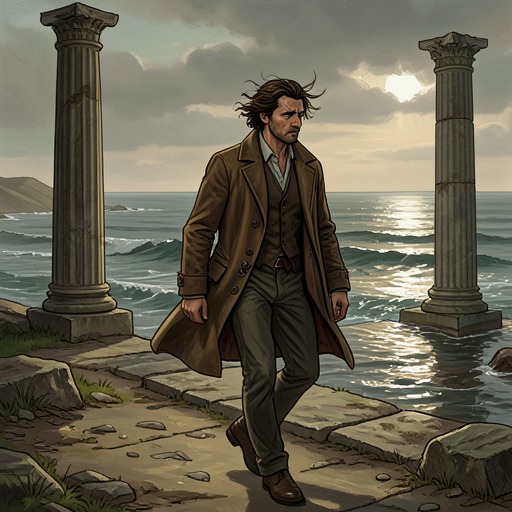
Tipasa is reached from Algiers by a road of sixty-nine kilometers and lies beside a bay bordered by the Chenoua, a massive mountain that seems to rise from the sea as a solidified wave. Its landscape is composed of ruins, wormwood, olives, columns, beaches, flowers, and intense Mediterranean light. The site is not presented as a decorative antiquity alone. It is a place where land, sea, weather, stone, and the human body meet with unusual immediacy, allowing the narrator to experience existence before it is reduced to political history or moral abstraction.
The surrounding world gives Tipasa a significance that exceeds its physical boundaries. The narrator contrasts it with the great European cities, which are burdened by centuries of revolutions, empires, fame, and historical noise. Big cities have become the authorized locations of consciousness because history is said to exist in their streets; nature, the sea, hilltops, and evening meditation have been deliberately pushed aside. Tipasa answers that historical monopoly with a landscape whose silence and permanence expose the limits of history. Its ruins are not dead monuments but a continuing presence against which modern constructions, wars, and ideologies appear temporary.
Memory and the First Loss
More than twenty years before the later return, the narrator spent whole mornings wandering among Tipasa’s ruins, breathing the wormwood, warming himself against the stones, and discovering small roses whose petals were soon plucked but which outlived the spring. At noon he escaped the consuming glare, and at night he slept open-eyed beneath a sky filled with stars. He describes that earlier self as fully alive: youth, sensual freedom, the sea, beaches, physical strength, and an unbroken sky formed a single experience of abundance.
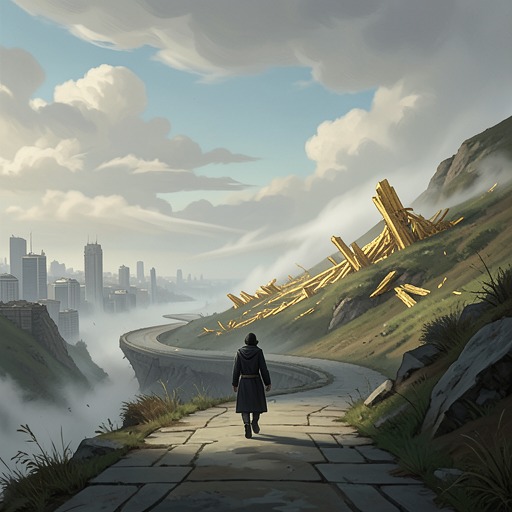
A later visit, fifteen years after the first, revealed that the place had been altered and that the alteration belonged to the narrator as much as to the ruins. The site was now enclosed by barbed wire, accessible only through designated openings, and guarded during the day. Walking there at night was forbidden. The old freedom had become a regulated memory, and the narrator could no longer simply re-enter the world he had loved. On the morning of that visit, rain covered the ruins, intensifying the sense that the past had not merely become inaccessible but had been obscured.
The decisive historical rupture is dated precisely: on September 2, 1939, the narrator did not go to Greece as planned because war came to Europe and then spread to Greece itself. The distance between the warm ruins and the barbed wire therefore corresponds to the distance within him. He had been raised amid beauty, which was his only wealth; afterward came tyranny, war, police forces, and the era of revolt. The world showed its wrinkles and wounds, and the narrator recognized that he and his generation had aged with it. They had once been innocent without knowing it; now they were guilty without intending to be, while the growth of knowledge only deepened the mystery.
The Return Through Rain
The later return begins in Algiers after five days of incessant rain. The city that had once been the narrator’s city of summers has been emptied of laughter; cafes distort familiar faces, and the narrator recognizes in those faces a lost youth that can no longer be named. He waits without fully understanding what he is waiting for, except perhaps the chance to return to Tipasa and test whether the old freedom can still be found.
The attempt is knowingly dangerous. Returning to the places of youth in order to relive what was loved at twenty is described as a kind of madness, especially at forty. The narrator does not confuse memory with restoration: he knows that time cannot be reversed and that the world’s former appearance has disappeared. Tipasa is therefore not a magical repair of history. It is a difficult site of recognition where the desire to recover the past must pass through the knowledge that the past is irrecoverable.
The journey becomes possible only when the weather changes. After the rain stops, a clear morning rises over the sea, and the washed sky gives every house and tree a sharp, astonished newness. The narrator takes the road again, carrying with him the accumulated sensations of childhood and adolescence: the bus’s motor, unspoiled girls, beaches, young bodies at the height of effort, evening anxiety in a sixteen-year-old heart, and the recurring sea and sky. Yet he does not pause to admire the sea; he wants first to see the Chenoua, the mountain that has remained a refuge and harbor for its sons, including himself.
Recognition Among the Ruins
At last the narrator passes through the barbed wire and enters the ruins under a glorious December light. From the forum scattered with olives he sees the village below, silent except for wisps of smoke. The sea is equally quiet, and a distant cock’s crow marks the fragile glory of the day. Around him are pock-marked stones, wormwood, trees, and perfect columns suspended in crystalline air. For a moment the morning seems stabilized, as if the sun had stopped and the years of wrath and night had begun to melt.
The silence is not emptiness. The narrator gradually hears its constituent sounds: birds, the brief sighs of the sea below the rocks, the vibration of trees, the columns’ “blind singing,” wormwood, and furtive lizards. These sounds awaken something that had seemed to have stopped within him. His heart begins calmly to beat again, and the experience becomes both auditory and bodily: happiness rises inwardly as the landscape resumes its life. The apparent stillness cannot last. The sun climbs, a magpie calls, and birds erupt into energetic, jubilant discord. The day begins again and carries him toward evening, replacing the fantasy of arrested time with a renewed participation in time.
At noon, on slopes half covered with sand and heliotropes, the narrator watches the exhausted sea and satisfies two indispensable hungers: loving and admiring. This recognition connects Tipasa directly to the political crisis of the present. Violence and hatred dry out the heart; the struggle for justice can exhaust the love that originally gave birth to it. Justice by itself is insufficient if it becomes as barren as an orange whose beautiful skin conceals only bitter pulp. Tipasa restores the freshness and joy that must remain intact if a person is to return to combat without allowing combat to define the whole of life.
Meaning and Lasting Consequence
Tipasa’s beauty does not defeat history, cancel guilt, or remove the narrator from Europe’s struggles. Its function is more demanding. The ruins show that the world can begin again each day in new light, and that this renewal is older and more durable than modern constructions or the damage left by bombs. The narrator’s recovered memory of the site has preserved him from despair even when he could not consciously draw upon it.
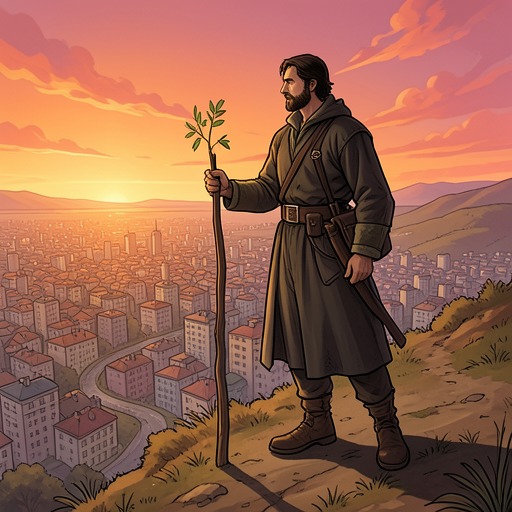
The central revelation is expressed through a seasonal contradiction: in the middle of winter, the narrator discovers within himself “an invincible summer.” The phrase names an inward resource formed by the remembered conjunction of light, sea, bodily life, love, and admiration. It is not innocence recovered in its original form. The narrator knows too much to return to the unknowing freedom of youth, but he can carry the memory of that freedom into an age of tyranny and revolt.
After leaving Tipasa, the narrator returns to Europe and its struggles. The memory of the December day helps him welcome what delights and what crushes, refusing the false choice between light and servitude, beauty and political responsibility. Tipasa thus becomes neither an escapist paradise nor a picturesque ruin. It is a temporary harbor whose lasting gift is ethical: it teaches the narrator to braid the forces of joy and suffering into one cord stretched nearly to breaking, and to take the light of the landscape back into history.